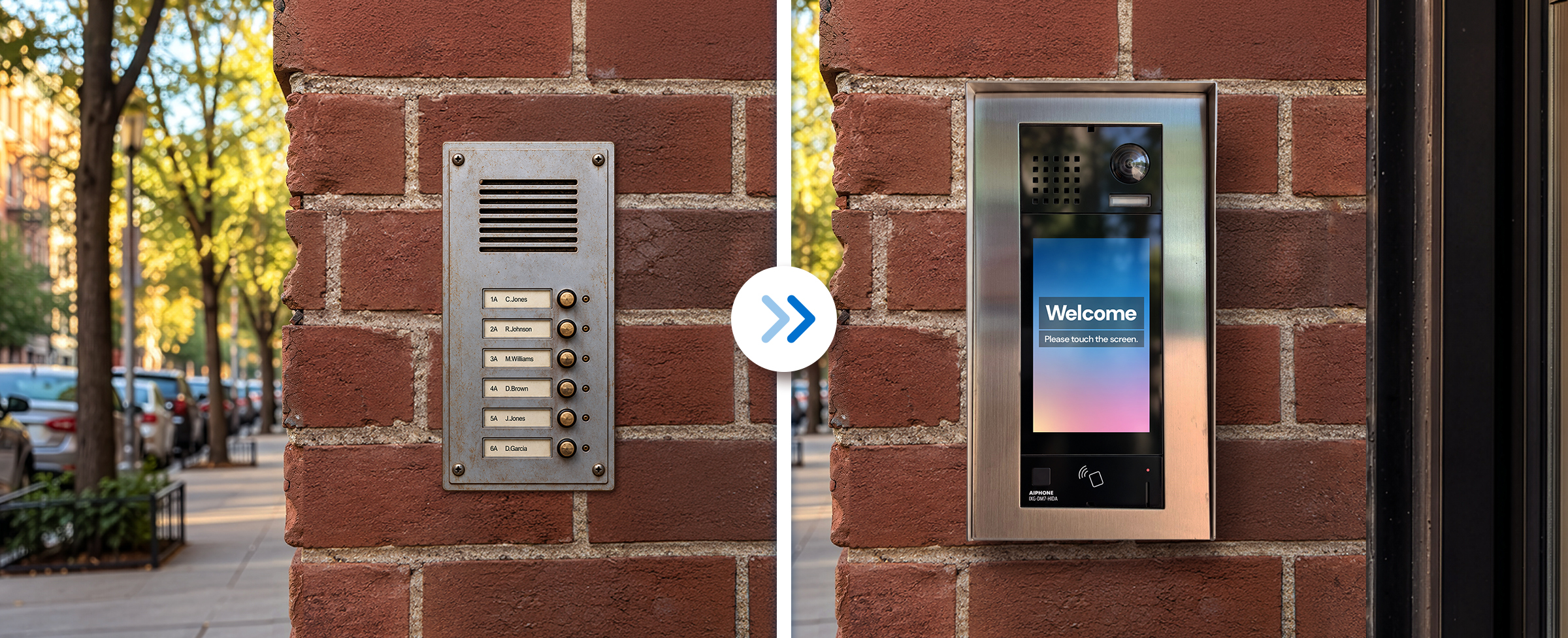
A secure property depends on building entry communication provided by an intercom system. To maintain safety, the intercom must operate without performance issues or disruptions. If a building’s current system is malfunctioning or outdated, the way forward is to upgrade. This guide will illustrate when an intercom should be updated, cost considerations, system assessment requirements, and suggestions for selecting a new intercom.
Signs That It’s Time to Replace an Intercom System
Broken System
The main indication of an intercom malfunction is when a user presses a button and nothing happens. Other common problems include random or inconsistent alerts and static disruptions to audio or video communication.
Whether these issues have been observed firsthand or reported through user complaints, upgrading to a newer, more advanced system is important. This is because repeated communication problems negatively affect property image and the user experience of students, tenants, employees, or visitors.
Need to Boost Property Image
If residents or guests struggle to enter through doorways or contact a receptionist, their perception of the property may suffer. Aesthetics also influence user perceptions. Systems that appear worn from extensive use and long-term outdoor exposure can detract from a building’s appearance. On the other hand, a modernistic intercom design, or one that is sleek, durable, and without visible ware, can reinforce the impression that a residential or commercial property is well-maintained, operable, and up to date.
Missing Features and Integrations
Even if a system is not broken or worn, it may be outdated. This means that it lacks the latest features that would otherwise contribute to a security ecosystem—an environment where multiple integrations work together to create a safe, secure space.
Today, intercoms are responsible for more than a simple two-way conversation. An upgrade could allow for an intercom to provide video, as well as audio, communication, personalized access control, and the incorporation of mobile apps to unlock doors and monitor deliveries. These are only some of the additives that make an intercom system excel in protecting a property. Many more, explored further below, have become essential to building security, depending on the individual needs of each property.
Cost Considerations for an Intercom System Upgrade
The cost of an upgrade project depends on two major factors: building type and recycled intercom hardware. Large settings like schools, corporate campuses, and apartment or commercial buildings will naturally be more expensive than a single-family home or a small business. However, a key part of any intercom upgrade is the re-use of already existing infrastructure. Hardware components, mainly wiring, can in most cases be salvaged, meaning that some new material does not need to be purchased or installed.
Property owners and managers should not be discouraged by the potential scale of an upgrade. “It’s worth it to buy a better intercom upfront, one that gives you more features, the expandability you need, and the reliability to stay relevant five years from now,” says Ben Jobrack, Product Department Manager at Aiphone. With experience implementing intercoms on different scales and in diverse settings, Aiphone is prepared to take on projects at any capacity.
How to Upgrade an Old Intercom System: A Step-by-Step Walkthrough
Knowing the extent of an upgrade is done by surveying the intercom system that is already in place. This includes examining current intercom type, building type, and integrations.
Step 1: Identify Your Current System
To select a new intercom, begin with understanding the original system. Is the intercom analog or IP? An analog system transmits audio and video communication through multi-conductor wiring. An IP system can also use wiring for Ethernet connection, in addition to allowing connection through Wi-Fi. It also supports modern features like mobile access, remote management, and further integrations with other security systems.
An upgrade from an analog to IP system may be called for if the analog system is lacking features and integrations that only an IP intercom can provide. A change from an older analog system to a new one might also be necessary. Either way, school administrators, building owners, and property managers need to know what they are looking for: different capabilities that better contribute to a security ecosystem, a new, pristine look, or both.
Step 2: Inspect System Wiring
While property owners do not survey wires, security integrators do. They check wire types, test how well the wires perform, and confirm compatibility with converters and other technologies. If the wires are physically damaged, the integrator will converse with the client about purchasing new material. If the existing wires are in good condition, they can be reused to connect to the new intercom that replaces the old system.
Step 3: Choose The Best Method for Transition
There are three ways to go about an upgrade. With Aiphone, the following options can be chosen:
- In an analog-to-analog case, make use of existing wiring as a new system is implemented.
- Use an Analog-to-IP converter. This takes audio and video, signals from older infrastructure and converts them into digital data packets that can travel over an IP network. Ultimately, it prolongs the use of existing analog wiring.
- Run the IP intercom system on the existing network infrastructure. Example: a school with an established network can phase out its analog system and add the new intercom directly to the network.
Regional Aiphone support experts or an integrator will aid in assessing and deciding what route to take, as well as explain what infrastructure can be reused.
Step 4: Select a Call Answering Method
With a modern IP system, customization can be extended to call answering methods with a physical answering station, mobile app, telephone communication, and desk phone integration. Choosing the best option is a personal choice based on what is most convenient. If a building has a front desk, a phone might be more appropriate than a mobile app notifying a user of activity or requested access. For small settings, or, perhaps, one where an owner or manager is on-site, an app may be exactly what a user is looking for to ensure visibility and personal advantage. At length, call answering methods depend on an establishment’s staff, setting, and personal preference.
Step 5: Decide on Further Integrations and Add-ons
Call transfer refers to directing calls to the right people without interrupting the wrong individuals and pausing everyday tasks. Instead of a visitor using an intercom blindly, not knowing who will answer the call, a customizable directory can allow a user to contact a specific person without inconveniencing others and delaying the communication process.
Another perk to consider is paging. Aiphone intercom systems combine communication methods, bridging the gap between paging and standard two-way conversation. Stations provide audio outputs that connect to third-party amplifiers, Aiphone intercoms, or both, allowing announcements to be distributed through established paging speaker networks.
Emergency towers and wall boxes may be a great addition to garages, parking lots, or courtyards, depending on property layout. In the event of an emergency, this option extends safety and provides help to students, residents, or employees when needed.
Finally, regarding access control, this is essential in environments that want to monitor and dictate who can enter a building using a key card or fob. Aiphone’s AC Nio simplifies the process of adding or eliminating the names and numbers of individuals within a building. It makes traffic flow, especially for busy environments, run smoother, ensuring that only the right people can enter an area at the right time.
Selecting a New Intercom System
Why Choose Aiphone?
As the world’s largest commercial intercom and security communications manufacturer, we offer a wide range of IP and analog solutions that cater to any environment. Over seventy-five years in the industry have given us the privilege of upholding safety and security at large enterprises like Amazon and Mariott, in addition to providing smaller businesses, apartments, and single-family complexes with intercoms designed for usability and property protection. Our values of clear communication and quality are emphasized in our products:
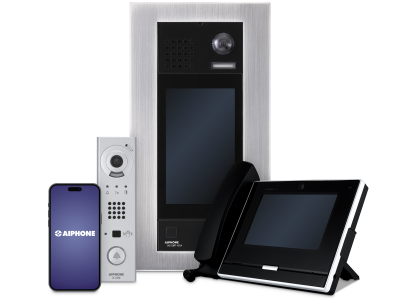
IX | IXG Series IP Video Intercom
Aiphone’s classic IX | IXG intercoms offer a solution that can span across multiple buildings. With AiphoneCloud, a succinct system management platform, and access control provided by AC Nio, this integration-rich system fulfills the safety and security needs of any large facility.
Explore the IX | IXG Series
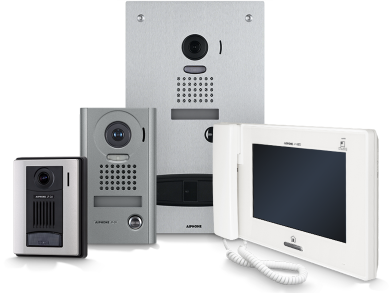
JP Series Analog Video Intercom
Both vandalism-proof and weather-resistant, Aiphone’s JP Series is a great security solution for storefronts and small offices. It provides two-way video communication with visitors, entrance monitoring, and customized call partitioning, as well as a clean design to elevate any setting.
Explore the JP Series
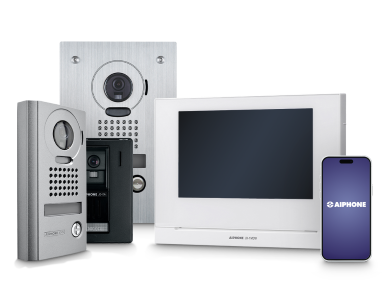
JO Series Analog Video Intercom
For single-family homes, rental duplexes, or offices, Aiphone’s JO Series uses physical tenant stations compatible with mobile apps for remote monitoring and access. Additionally, it gives control over secondary devices like lights or gates for added personal convenience.
Explore the JO Series
Frequently Asked Questions
How do you upgrade an intercom system?
For a new system to excel, the old system will have to be understood based on intercom type. Next, wiring should be looked over, followed by a transition to a new system with either a converter, recycled wiring, or running the IP intercom system. After a call answering method has been selected, the process ends with choosing and implementing further integrations and add-ons, from access control to paging. A user with a security or facilities team can navigate this process with Aiphone’s assistance, a dealer’s help, or independently.
How much does it cost to replace an old intercom system?
Cost varies. Existing infrastructure, user needs, integrations, and scope are all factors that contribute to the price of a replacement. Sometimes changing intercoms includes a simple swap. In other situations, an upgrade might be a part of a large-scale security enhancement project.
Should you repair or replace an old intercom system?
If the intercom is modern, has a functional problem unrelated to the rest of the system, and operates well otherwise, simple repair is reasonable. If the intercom is older, several different functions are failing, and it lacks integrations that would make it a more comprehensive solution, an upgrade is necessary.