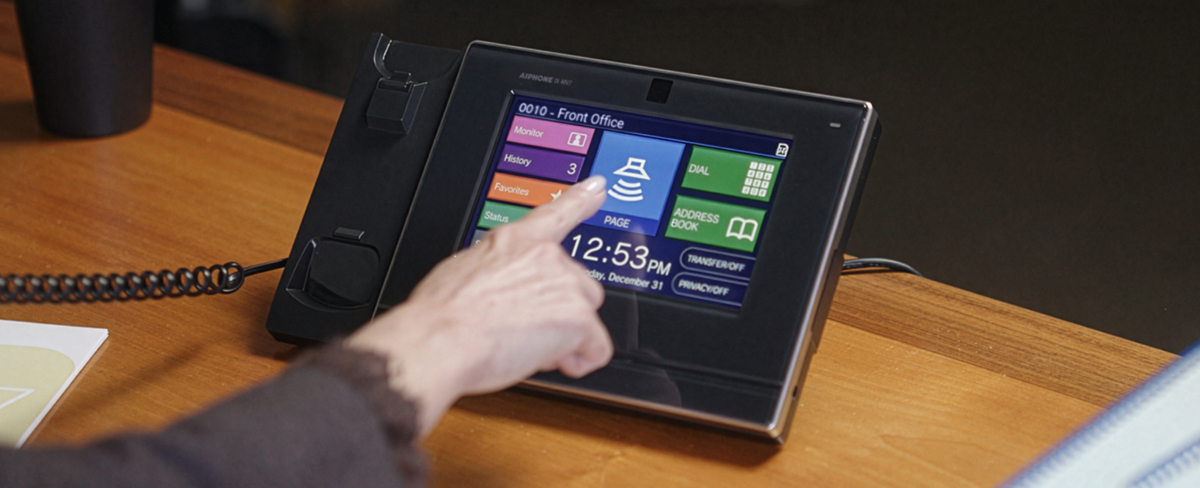
Creating a learning environment that is welcoming and focused requires reliable communication tools. School paging systems support daily announcements, routine updates, and emergency messaging through one-way communication. However, paging is only one part of a comprehensive K-12 communication solution. Intercoms that integrate with paging systems add critical capabilities, including two-way communication and access control.
This guide takes a closer look at the relationship between paging and intercoms, as well as how paging falls short without an IP security communication solution.
Paging Systems for Schools
While not a complete solution on its own, paging is a good starting point for school-wide communication and adherence to safety protocols. When a receptionist, principal, or other staff member speaks into a microphone in the main office, an amplifier magnifies their voice and distributes it through speakers located throughout the school. This system ensures announcements can be heard across multiple areas of the building.
Aiphone provides amplifiers in addition to two speaker options: ceiling speakers for classrooms and horn speakers for outdoor or larger spaces, helping ensure important information reaches every corner of a school.
The Difference Between Intercoms and Paging
Paging refers to mass, one-way broadcasting intended for immediate communication. It is designed to be heard by anyone within range and does not require or expect a response. Intercom systems, by contrast, support targeted, two-way communication between specific locations or individuals. For example, a faculty member may contact a particular classroom, where a teacher or student can respond, enabling a direct conversation.
Aiphone intercom systems combine both communication methods, bridging the gap between paging and intercom functionality. Equipped with microphones and speakers, they support two-way dialogue while also serving as paging devices. In addition, they can be integrated into existing infrastructure. Aiphone stations provide audio outputs that connect to third-party amplifiers, allowing announcements to be distributed through established paging speaker networks.
Limitations of Paging Systems for School Emergencies
Emergency responses often include paging, particularly when announcing lockdowns or broadcasting automated shelter-in-place messages. These notifications represent one component of a broader safety incident protocol, which may also involve system-wide responses, visual and verbal communication, and additional instructions delivered through text messages or repeated broadcasts.
There are, however, limitations to paging. A one-way announcement does not provide the level of situational awareness that can be achieved through direct communication. Paging is also typically group-based, meaning it cannot be used to reach a specific classroom or individual when targeted communication is necessary. In addition, traditional paging systems often require speakers within the same paging zone to be physically wired together and connected back to an amplifier. If the necessary wiring is not already in place, additional cabling may be required. This makes installation more complex and less adaptable than modern IP-based communication solutions.
Benefits of a Unified Paging and Intercom System
Without an IP security communication solution, paging falls short. When integrated, paging and intercom systems work together to play a critical role during emergencies, with two-way communication between classrooms and administrative staff serving as a core function. Additional benefits that support this goal include mass notification via emergency towers, integration with cameras and access control, and reduced overall system costs.
Enhance Coordination and Awareness
Teachers can report headcounts to the main office, provide updates on classroom conditions, or receive further guidance on how to respond during a drill or an actual emergency. This ongoing communication helps administrators maintain situational awareness and coordinate an effective response across a school building.
Mass Notification for Faster Emergency Response
Paging is one pillar of mass communication, which includes audio announcements alongside other notification methods such as SMS, email alerts, desktop notifications, mobile app notifications, digital signage, and visual alerts. For example, a lockdown alert may be broadcast through Aiphone blue light tower speakers or wall boxes while messages are simultaneously sent to staff and parents. This type of coordinated response is made possible through integration with Alertus, a mass notification platform that distributes emergency alerts across multiple channels.
Integration with Cameras and Access Control
IP cameras and access control provide real-time visual verification and entry management from a single platform. Staff can see and communicate with visitors at entry points, confirm identity before granting access, and remotely unlock doors when appropriate. In emergency situations, live video feeds support faster decision-making by giving administrators immediate visibility into building conditions and potential threats. This integration reduces response time, improves accountability, and strengthens overall situational awareness across school property.
Reduced Costs and Complexity
A unified paging and intercom solution is cost-effective because it extends beyond classroom communication alone. Rather than relying on separate systems, schools can incorporate door security, access control, video surveillance, and emergency communication into a single integrated platform. This simplifies system management, reduces infrastructure duplication, and lowers long-term maintenance and operational costs.
Factors to Consider When Choosing an Intercom and Paging System
If school administrators are prioritizing a solution that integrates door entry, classroom communication, and paging into one scalable platform that can grow over time without requiring full system replacement, here are some factors to consider:
- Size and layout of the facility determine the design, coverage, and equipment needed for an intercom network. Consider whether a school has extensive grounds, multiple buildings, multiple floors, or a smaller footprint where a more centralized solution may be appropriate.
- Existing infrastructure for IP vs Analog indicates operation requirements. IP-based intercoms typically use the school network and may offer easier scalability and integration, while analog systems may require additional hardware or upgrades to connect with newer solutions. However, IP intercoms such as the Aiphone IX | IXG Series can also bridge this gap by integrating with existing analog paging systems, allowing schools to retain their current speaker infrastructure without requiring a full system replacement.
- Number of classrooms impacts how many intercom stations and speakers are needed. Schools should examine where two-way communication is required and which areas need to receive announcements.
- Physical master stations and answering stations affect how schools manage communication and emergency response. Features such as speed dial buttons help staff initiate announcements quickly, while handset and hands-free answering options provide flexibility for different roles and environments.
- Indoor, outdoor, or campus-wide coverage implies speaker placement, paging zones, and whether additional equipment is required for areas such as parking lots, athletic fields, courtyards, or separate buildings.
- Mass communication methods include audio announcements, visual alerts, text messages, mobile notifications, digital signage, or other emergency communication tools. The right combination ensures information reaches staff, students, and visitors through multiple channels.
- Cloud-based management simplifies routine system updates and reduces the time needed to manage users, paging groups, bell schedules, and other recurring tasks. AiphoneCloud’s Remote Management allows school IT managers to make changes remotely and apply updates across multiple buildings or campuses.
Frequently Asked Questions
Paging is a component of intercom systems and refers specifically to one-way announcements broadcast throughout a building. Intercom systems, which may include paging functionality, support two-way communication and often extend to additional capabilities such as video calling and access control integration.
Paging is a component of both intercom and mass notification systems and refers specifically to announcements made over a microphone and broadcast through speakers. Mass notification includes paging but extends further, encompassing multiple communication channels such as text messages, email alerts, desktop and mobile app notifications, digital signage, strobe lights, and other visual or audible alerts.
Yes. In most cases, a school intercom system can do everything a paging system can do because paging is a feature within a larger intercom solution. While paging systems provide one-way announcements, intercom systems add two-way communication between classrooms, offices, and entrances, often alongside emergency notification and other safety features.
With every location on the same network, Aiphone simplifies deployment and management across the entire district through AiphoneCloud. At the operational level, call transfer and paging work seamlessly between schools, and calls can roll over directly to the district office where the SOC is, keeping communication connected from the classroom all the way up to district leadership. For help setting up an AiphoneCloud account, please contact one of our experts in your region.
The K-12 PASS (Partner Alliance for Safer Schools) guidelines encourage schools to take a layered approach to safety. In practice, that means choosing a reliable security communication solution that supports daily operations and emergency response while integrating with cameras, access control, and other security technologies. Schools should look for flexible solutions that can adapt to changing needs over time.