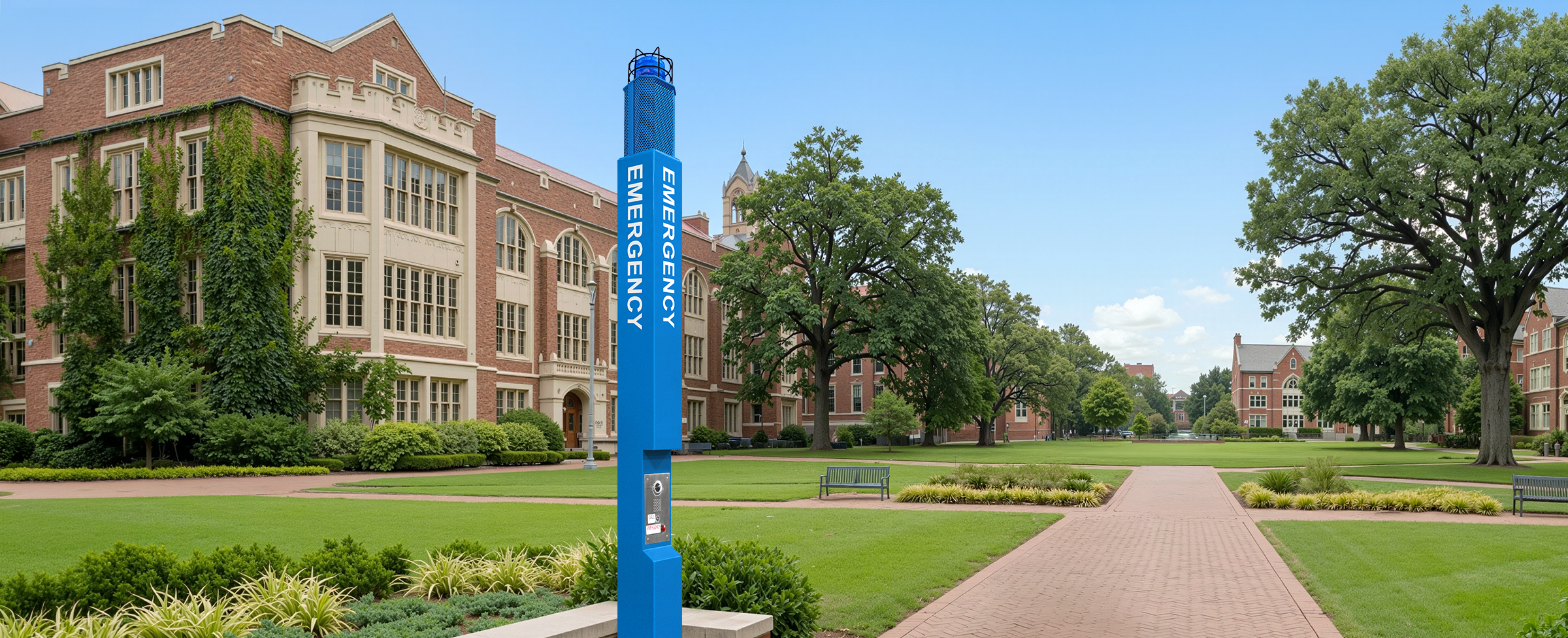
Walking past a blue light emergency phone is something most students and staff do without thinking twice. It blends into the background of a college campus the same way a fire extinguisher does, and like most infrastructure that rarely gets used, it’s easy to let routine checks slip down the priority list.
This guide covers everything you need to know about blue light emergency phones. You will also find a self-audit checklist to help you assess your current system, identify gaps, and take steps toward creating a safer campus.
What Are Blue Light Emergency Phones?
Blue light emergency phones, also called emergency call boxes, are dedicated emergency communication systems installed across campus and buildings, designed to connect anyone in need directly to campus security or emergency responders.
How Do Campus Blue Light Emergency Phones Work?
When someone presses the button, the system immediately initiates a hands-free two-way call with a dispatcher, who can see which unit was activated and where it sits on campus. If the primary line is busy or goes unanswered, SIP emergency phones can roll over through pre-programmed numbers until someone picks up.
Once connected, the call remains active until the dispatcher ends it, ensuring communications stay open during an emergency. The blue light strobe on top begins flashing, giving responding officers a clear visual reference point to locate the unit quickly.
Common Types of Campus Blue Light Emergency Phones
Blue light emergency phones come in several forms, and most campuses use a combination of types to cover different areas effectively.
Blue Light Emergency Phone Towers
Blue light emergency phone towers are the most recognizable form and the most commonly deployed outdoors. They work well in open areas like quads, surface parking lots, and athletic fields where visibility from a distance is the priority. Their height and blue beacon make them identifiable even in low-light conditions.
Wall-Mounted Emergency Call Boxes
Wall-mounted emergency call boxes are commonly used for indoor environments, such as parking garages, building entrances, and stairwells. They take up less space, mount directly onto surfaces, and support the same audio and video capabilities as a tower.
Solar-Powered Wireless Blue Light Emergency Towers
For locations where running power or cable isn’t feasible, solar-powered blue light towers provide the same emergency communication functionality without the infrastructure cost.
What Customization Options Are Available?
Besides height and color, here are additional customizations and upgrades you should consider for your blue light emergency phones:
Audio-Only or Video Emergency Intercom System
Audio-only campus emergency phones are the baseline and remain widely deployed. However, emergency video intercom systems give dispatchers visual context the moment a call comes in, allowing them to assess the situation before a responding officer arrives on scene.
High-Power Speaker
Emergency phone towers equipped with high-power speakers are worth considering for large open areas where audio clarity over distance matters. Instead of having to integrate a public address system, a campus emergency phone with a high-powered speaker built-in allows the dispatcher to broadcast campus-wide announcements through the same units during an active emergency.
Camera Arm
A camera arm extends visibility beyond the video intercom and provides a wider field of view of the surrounding area. When integrated with VMS, it can provide responders with more actionable information, including timestamps and recordings of the incident, which can meaningfully improve response outcomes.
Assistance or Emergency Lettering
Most manufacturers provide Emergency and Assistance lettering customizations; however, which one to use is often determined by local or state code. Please consult with a safety or compliance professional on your campus.
Integration with Campus Security Systems
Modern blue light emergency phone systems can integrate with access control platforms, video management systems, and mass notification. When a station is activated, an integrated system can trigger a coordinated campus-wide response automatically, from locking doors to pushing text alerts.
What Makes a Blue Light Emergency Phone ADA Compliant?
The Americans with Disabilities Act (ADA) ensures that people with disabilities have equal access to public spaces and services, including emergency communication systems. For blue light emergency phones, this means hands-free operation, push buttons mounted at an accessible height, and accessibility features such as braille signage, raised lettering, and LED indicators.
Why do Campus Blue Light Emergency Phones Still Matter?
The case for blue light phones is less about replacing cell phones and more about the broader effort to provide multiple emergency contact options and improve campus safety. It’s also about meeting local codes and federal laws, and knowing there’s a reliable, dedicated system that works regardless of circumstances, signal strength, or battery life.
Visible Sign of Campus Safety
Blue lights are a powerful visual reminder to students and parents that campus security is taken seriously. A well-placed network of emergency phone towers changes how people move through a campus, where they feel comfortable going, and whether they feel secure after dark. At the University of Delaware, 90% of students reported that the presence of blue light stations makes them feel safer, whether or not they ever use one.
Reduce Crime Rate
Beyond increasing the perception of safety, blue light stations have a measurable impact on reducing crime. Rice University saw on-campus burglaries drop 68% after 80 blue light emergency phones were installed. The University of Houston has maintained the lowest total violent crime rate among flagship public universities in Texas in 2024, supported in part by a network of 240 blue light phones alongside a mobile app and direct call and text lines.
Increase Enrollment Rate
Campus safety is consistently one of the top factors in college decision-making, and visible emergency phones are a meaningful part of that conversation for both students and parents. At Harvard, where 530 phones are installed across campus, most activations involve everyday requests like directions, lockout assistance, and night escorts. Purdue University has taken the same approach, expanding its network to nearly 300 call boxes to serve students, faculty, and visitors alike.
Required by Federal and State Laws
The Clery Act requires colleges and universities that receive federal funding to report campus crime data and details about efforts taken to improve campus safety. While the Clery Act is one of the most notable campus safety laws, many states have their own campus safety requirements, which all point to the necessity of having an emergency communication system to ensure campus safety.
A Self-Audit Checklist: Modernizing Existing Deployments
Most campus emergency communication systems were installed piece by piece over many years. The older technology in place often lacks video capability, and oftentimes, the only way to know if the system is working is to have people walk around campus to place test calls. This checklist gives you a starting point to evaluate your system as a whole.
Part 1: Inventory Your Existing System
- How many blue light emergency phone towers and call boxes are currently installed on campus?
- Do you have an up-to-date map showing the location of every unit, including parking lots, stairwells, and athletic fields?
- Are blue lights fully operational on each unit?
Part 2: Power and Cabling
- What type of cable runs to each unit: Cat3, twisted pair, Cat5, Cat6, or other?
- Where does everything run back to?
- Is the existing cabling in good condition?
Part 3: Condition Assessment
- Are the units visibly damaged or vandalized?
- Does the intercom produce clear, reliable two-way audio?
- Are call buttons responsive?
- Are your blue light emergency phones ADA-compliant, including mounting height, raised lettering, and braille?
- Do you have a protocol in place to verify the functionality of the intercom on a daily, weekly, or monthly basis?
Part 4: Call Routing
- When a student activates a unit, who does it call?
- Can calls be transferred or escalated if the primary recipient doesn’t answer?
- Does the system identify which specific unit is calling so responders know the exact location immediately?
- Has the call route been tested within the last 12 months?
Part 5: Integration
- Does the intercom system support video, or is it audio-only?
- Are your blue light phones connected to cameras, mass notification, and video management systems across campus?
- Can the system trigger campus-wide alerts or prerecorded messages in an emergency?
Modern Emergency Blue Light Solutions
Aiphone’s intercom systems and emergency blue light phone solutions are designed to work with current campus infrastructure wherever possible, and our local experts can walk through your assessment results to identify the most practical path forward, whether that’s a planned upgrade, a full system review, or just answering the questions you didn’t know you had.